by DALC Staff | Apr 3, 2024 | Conservation Easements, Land Protection, Legacy Society

Paul Klawiter and David Kopitzke
What are some ways to leave a positive, lasting impact on our world? Helping found a land trust is a pretty good one. So is a permanent conservation easement on private land with diverse native ecosystems. Joining DALC’s Legacy Society and supporting our future is another. And David Kopitzke and Paul Klawiter have done all three.
Their deep love and care for the Driftless began nearly fifty years ago. Paul grew up in Eau Claire, and David grew up in Indiana. They met at UW-Madison, and later David ended up in Milwaukee. But since they were both nature lovers, they wanted to live out in the country, and started searching for a spot. On field trips for his master’s degree in plant ecology, David had been out to Southwest Wisconsin. “I said, oh, that’s a pretty part of the state, let’s look there.”
And in 1974, they found the perfect place: fifty acres tucked into a steep valley in Richland County, part of a former farmstead. Over the years, they were able to add another thirty-plus acres. This land showcases nearly all the diversity of habitats the Driftless has to offer. It ranges from a small hilltop prairie to a wetland along a river bottom. There are warmer, drier south-facing slopes supporting oak and hickory, and cooler, shadier north-facing slopes supporting maple, basswood, and yellow birch, which is uncommon in this part of the state. A small spring flows into a trout stream that leads to a four-acre wetland, a later addition to the property. “That’s where we hear spring peepers,” David notes.
The wide range of native plants on the land was a great match for David’s skill in botanical illustration, as well as the native plant nursery he ran on the property for ten years, with woodland flowers growing under a big maple in the front yard. The old barn offered abundant hay for mulching their garden. In return, Paul and Dave worked to steward the land, especially by planting, tending, and protecting oaks. The combination of working full-time and owning a large property meant it was important to pick their battles when it came to restoration projects. But Paul still picked a big one: clearing out the black locust blanketing the hillside behind their house.
Originally found further south of our region, black locust trees are fast-growing and have been widely planted for erosion control. Unfortunately, they spread rapidly and form dense stands that crowd out native species. They also resprout from roots and cut stumps, making them very difficult to remove. But Paul’s arduous fight against the black locusts paid off – first with lots of firewood, and today with a young forest of diverse native trees where ephemeral wildflowers bloom in the spring.
While David and Paul were growing oaks and wildflowers, something new was growing all across Wisconsin: the land trust movement. Responding to increased suburban sprawl and loss of farmland, conservationists all over the state came together in the 80s and 90s to create organizations that could protect special places forever.
At the time, David was working for the DNR’s Bureau of Endangered Resources. In the late 90s, he was part of a group of conservationists brought together by Vicki Elkin, then the executive director of Gathering Waters, Wisconsin’s alliance for land trusts. David and others agreed that the Driftless Area needed protection. But who would provide it?
To the east of the Driftless, Groundswell Conservancy (originally the Dane County Natural Heritage Foundation) was founded in 1983, and on the river bluffs to the west, Mississippi Valley Conservancy was founded in 1997. But both organizations were too busy to expand into the heart of Wisconsin’s Driftless Area.
“So,” David says, “we bit the bullet and started a separate land trust.”
David credits DALC’s early success with board members who brought lots of diverse talents to the table. Eventually, the young organization hired its first staff member, started closing conservation easements, and kept growing, becoming nationally accredited in 2017.
“Accreditation is very important,” David notes. “It makes the whole organization more credible.”
From the start, David and Paul hoped that their property would be eligible for a conservation easement with the organization they had supported from day one. Wanting to be sure that the easement was free from conflict, David was not involved in any board decisions. The merits of this diverse landscape were enough to warrant permanent protection, and the property received its conservation easement in 2015.
“Neither of us regret it or had any hesitation about doing that,” Paul says.
Today, the land will always have the protection of the conservation easement. Knowing that DALC will always be here to defend it, Paul and David decided to include us in their will to ensure that our organization has the resources it needs to keeping doing good work. But what else does the future hold for this place? And how can landowners prepare for it?
Biodiversity has always been a primary focus of land stewardship for David and Paul, but in the face of climate change, it’s even more significant. A tulip tree, historically found in warmer regions to the south and east of Wisconsin, is thriving in a neighbor’s yard, demonstrating how plant ranges are shifting north.
That’s why Paul and David emphasize flexibility, and, in David’s words, “Taking a long-term view.” Managing land for a broad diversity of species – instead of monocultures of aggressive plants, like black locust – enhances ecological functions such as food for wildlife, ground water recharge, and carbon storage. It allows species to find the resources they need or move to more suitable locations as conditions shift. Overall, thriving ecosystems are better adapted to a changing climate.
But biodiversity wasn’t the only reason for the conservation easement. “Also, in the back of both our minds, we didn’t want to see irresponsible development,” David says. “To me, that’s a big part of the reason for Driftless Area Land Conservancy – prevent the breaking up of land.”
Fragmenting land with houses and roads reduces habitat, increases weedy species, and prevents plants and animals from moving freely. As part of our goal to protect 16,000 acres of land in the Driftless by 2027 – doubling the amount we conserved in our first 20 years – DALC is striving to create large, contiguous blocks of protected properties that will forever support people, wildlife, agriculture, and beautiful views across the Driftless.
Paul and David both hope that more private landowners will see how important their role is in protecting and sustaining wildlife habitat, green space, and biodiversity.
“I think public lands are very important,” David says. “But for private landowners, it should be a responsibility, and really a joy, to do stewardship on one’s own property.”
Written by Emilee Martell

by DALC Staff | Oct 1, 2023 | Driftless Trail
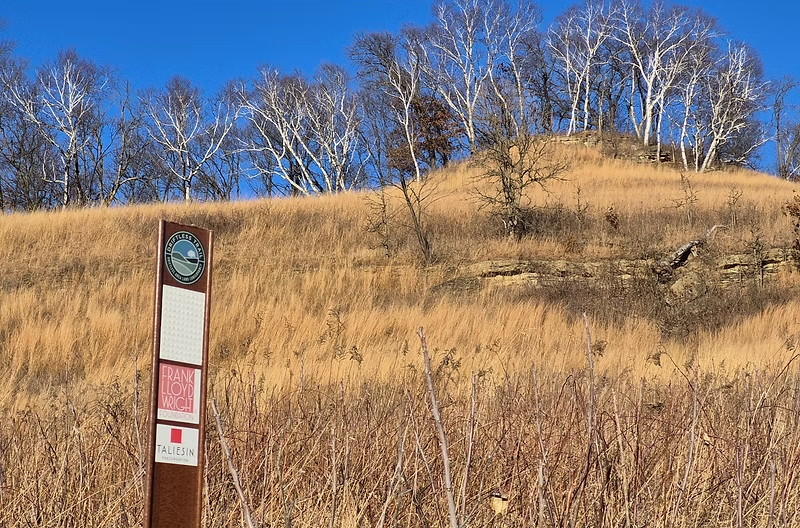
 After opening the re-routed Weaver Road Segment of the Driftless Trail last year, just north of Governor Dodge State Park, we are excited to announce great progress on two additional pieces of the Driftless Trail. The Knobs Road Segment, north of Ridgeway, is now in the “trial run” phase, open to a limited group who will provide feedback. In October, the Phoebe Point Trail on the Taliesin property, near Spring Green, will open to the general public.
The 2.7-mile Knobs Road Segment can stretch to a four-mile loop by walking Knobs Road in between the trail ends. This trail crosses a property where Dave and Ann Zimrin raise grass-fed beef, sold under the Butler Family Farm label. Hikers will pass through an old orchard, woods, prairies, a wide valley where cows are rotationally grazed, and a mile-long ridge with impressive views and perennial crops. The relatively short hike offers a lot of variety. Stay tuned for the official opening date.
Last year, Driftless Area Land Conservancy and the Frank Lloyd Wright Foundation agreed to co-brand the Phoebe Point and Welsh Hills trails on the Taliesin property as part of the Driftless Trail. Natural landscapes were integral to Mr. Wright’s designs, and from both of these trails, you get sweeping views of the landscape that, in his words, “picks you up in its arms and so gently, almost lovingly, cradles you.”
The 1.1-mile Phoebe Point Trail will be opened in October. It will traverse a slope where prairie and savanna restoration is in progress, then follow a ridge with views up and down the Wisconsin River and across much of the Lowery Creek watershed, including the Welsh Hills. This fall, we will also begin to construct an extension of the Welsh Hills Trail, which has been open to the public for several years.
By the end of 2025, we hope to complete the Driftless Trail from Tower Hill State Park through the Taliesin property. From there, we will route the trail south through the Lowery Creek watershed and begin trail construction on the Blue Mound State Park end of the project area.
As this project evolves, its value for educating people about nature and land management, protecting and stewarding a long conservation corridor, building community, and simply connecting people to this amazing landscape is becoming abundantly clear. We are immensely grateful to landowners who are making this possible by hosting the trail on their property and to volunteers who help on multiple fronts.
Enjoy hiking the Weaver Road Segment and (soon) Phoebe Point Trail by finding trail guides at driftlessconservancy.org/driftless-trail.
Written by Barb Barzen, Community Conservation Specialist
by DALC Staff | Sep 3, 2023 | Conservation Easements, Legacy Society
 In 2003, DALC completed our first-ever conservation easement. Twenty years later, our celebration of this milestone is bittersweet – the donors, Deane and Edith Arny, are no longer with us. But their tremendous legacy lives on in the Driftless.
For over forty years, Deane and Edith worked alongside their friends and family to restore a worn-out farm they named Valley Ridge in Richland County. Rolling, wooded hills were enrolled in Managed Forest Law for sustainable timber harvest. Old farm fields were seeded to native savanna through CRP. Despite bustling careers and personal lives – Deane was a professor of plant pathology at UW-Madison, and Edith was raising five children – land management was always a priority. Planting trees, removing non-native species, and carrying out prescribed burns kept the Arny family busy.
The land was also a place of celebration, including big Thanksgiving dinners with the family at the property’s century-old farmhouse – even though the only running water came from a nearby spring!
This love of their land brought Deane and Edith to the newly-minted Driftless Area Land Conservancy in the early 2000s. “I can remember going out there with a couple conservancy folks,” says David Kopitzke, a founding member of DALC and secretary of the board in 2003. “Deane and Edith were well up in years, but still both quite active. Deane took us up on the hill behind the house. I remember thinking, ‘Oh, this is just the kind of land DALC is concerned with protecting. I’m so happy it’s getting an easement.’”
Although the process of creating our very first conservation easement was nerve-wracking for DALC – “We were completely at sea,” David admits – the guidance of Gathering Waters, Wisconsin’s alliance for land trusts, made it possible. Today, Valley Ridge is owned and stewarded by the Leonardo Academy, a sustainability-focused nonprofit founded by Deane and Edith’s son, Michael Arny, where their daughter Dr. Barbara McCabe also works.
Deane passed away in 2013 at the age of 95, and Edith in 2022 at the age of 102. But they had one final gift for the Driftless.
Last fall, DALC was honored to receive an incredibly generous gift from the estate of Deane and Edith Arny – one of the largest donations in our history. Their kindness, commitment, and foresight to include us in their will has given us an amazing boost in capacity, enabling us to permanently protect more land in the Driftless region Deane and Edith loved.
“The first easement is when you’re really brought face-to-face with the idea of perpetual protection,” David recalls. “We were thinking, ‘how are we going to be able to do this forever’?”
Twenty years later, as DALC continues to grow and thrive, we have our answer: we can protect land in perpetuity with the support, dedication, and generosity of our community. We will forever be grateful to Deane and Edith Arny for putting their trust in us, and paving the way for a bright future of land conservation in our treasured Driftless region.

by DALC Staff | Feb 23, 2021 | Preserves
At the end of 2020, we received a remarkable gift: 300+ acres of a diverse Driftless landscape north of New Glarus. Thanks to the vision, dedication, and generosity of the local community, this special place was forever saved from development. At the time, we called this property Spring Valley Tract. But that name was always meant to be a placeholder, a temporary title while we got to know the land better. Now, after several years of exploration, restoration, and conversation, we are excited to share a new and permanent name:
Wild Oaks Preserve.

“Ryan’s Oak,” one of the most iconic trees at the preserve. Photo: Zach Pacana
This name was the result of careful thought and several rounds of community input. Below, site steward Fil Sanna shares some of the things this new name signifies for him.
This name is simple, and yet encapsulates several important aspects of the land and the project.
First, oak trees are a prominent symbol of the landscape. Even though the property is hugely diverse – containing oak woodland and savanna, native prairie, several types of wetlands, a spring-fed stream, pastures, and tilled cropland – almost anywhere you go, you are within sight of oaks.
Oaks are also a keystone species – one that helps define and hold together the entire ecosystem. Countless insects, birds, mammals, and smaller plants depend on oaks. Accordingly, we are working to preserve the oaks that are there and improve conditions for new oaks to sprout and survive.
As for the “Wild” part, the site was once wild and we are working to make it (relatively speaking) wild again. I’ve been fortunate enough to visit true wilderness in the mountains, and have pictured in my dreams how the vast tallgrass prairies of southern Wisconsin might have once looked. It’s my hope that we can rekindle enough of the latent wildness of the land to evoke something of what our ancestors saw when they came through these hills. In the words of Terry Tempest Williams: “Wildness reminds us what it means to be human, what we are connected to rather than what we are separate from.” Our hope is that future visitors will find inner rejuvenation and outward community in the wild corners of this place.
One final note: the site is historically and culturally rich. How do we properly honor those who came before us? We have been in conversation with officers and allies of the Ho-Chunk tribe, and our work nurturing these relationships will continue. We have researched the history of and had conversations with families who lived on the land in the past. There were at least three homesteads there. We are preserving the old barns at the historic Sonsteby farmstead and converting the farmyard into the main entrance for the property. The other two homesteads have ruins that can be featured along future hiking trails. And we expect that there will be other naming opportunities within the site – a council ring, different trails, a boardwalk, and more – to honor those who came before us as well as those deeply involved in the current project.
This is a big moment for the Wild Oaks Preserve – we’ve come a long way since we acquired this property less than three years ago!
Thank you to all who have given their time, energy, support, and creativity to Wild Oaks Preserve. We are still working on safe access to the site. If you want to visit Wild Oaks, contact us, or attend one of our many work days or events there! Find details on our Events Calendar.
by DALC Staff | Jun 1, 2019 | Driftless Trail
A drive through northeastern Iowa County serves up incredible vistas, bucolic farm scenes, roller coaster topography, historic treasures, and a taste of rural life. We all love what we see out the window. Now stop and think what a hike through this same landscape would give you. Not only could you soak in all of the above up close and at your own pace, you could learn more, get exercise, enjoy quality time alone or with friends and family, and even take it all in on snowshoes or cross country skis.
What started as our executive director’s daydream about a looped hike from Tower Hill to Governor Dodge to Blue Mound state park through the amazing hills and valleys in between has, over the past three years, become a full-fledged proposal and community conservation strategy that DALC is now rolling out.
When completed some 15-20 years from now, the Driftless Trail will be a trail network that connect the three state parks, Trout Creek and Love-Strutt Creek Fishery Areas, Ridgeway Pine Relict State Natural Area, and many beautiful private conservation lands in between. A couple of campsites will allow people to do overnight hikes of 50 miles or more, and multiple small loops will allow for the 1-2 hour hikes many people prefer.
Indeed, wherever the trail wanders, DALC will ensure those areas are managed well. The long-term impact will be an extensive corridor of good-quality woodland, savanna, prairie, and wetland habitat that will allow for movement of wildlife, improve resiliency to climate change, and model land management techniques that trail users can learn from and apply elsewhere.
In addition to involving landowners, the Driftless Trail will engage and energize educators, businesses, youth organizations, health organizations, natural resource managers, and community leaders in the seven towns surrounding the project area: Dodgeville, Spring Green, Arena, Ridgeway, Barneveld, Blue Mounds, and Mount Horeb.
After developing a Concept Plan with assistance from the National Park Service and expertise of our planning and advisory teams, DALC is now incorporating input from landowners and the public into plans for moving forward. As momentum continues to build, more voices are adding their support for the trail:
“The Driftless Trail is exactly what visitors are looking for right now. They are looking for opportunities to get out in nature, to observe wildlife, but also at the end of the day be close to other amenities and attractions. The Driftless Trail makes all of that possible,” notes Anne Sayers, Deputy Secretary for the Wisconsin Department of Tourism.
If you’d like to support or learn more about the project, contact Barb Barzen at barb@driftlessconservancy.org